AMD Reports Progress on Agentic PCs and AI Technology
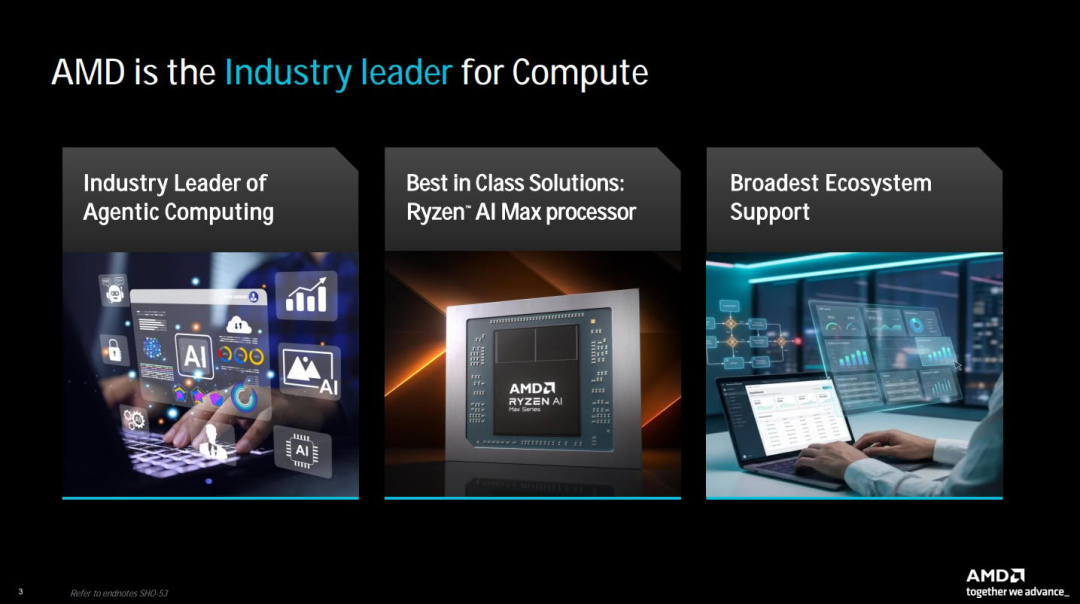
AMD recently held a press briefing to share updates on its Agentic PC initiative, revealing significant milestones in its development. The company announced that it has shipped over half a million Agentic PCs across more than 50 different designs. Additionally, AMD reported that it has delivered tens of millions of AI PCs, showcasing its commitment to advancing AI technology in personal computing.
The term "Agentic PC" refers to systems equipped with CPUs, GPUs, and NPUs capable of running AI agents locally. AMD emphasized that its Ryzen AI Max+ systems, particularly those with 64 GB of memory or more, provide the best user experience. The company introduced the Ryzen AI Max 400 series as the next generation of Agentic PCs, with a focus on its flagship model, the Ryzen AI Max+ PRO 495 "Gorgon Halo," which supports up to 192 GB of unified LPDDR5X memory.
For Your Trading Desk
Sponsor Spike Success.
During the briefing, AMD highlighted the performance capabilities of the Ryzen AI Max+ PRO 495, noting that it can handle large language models (LLMs) effectively. The chip is capable of running Z.ai's GLM 5.3 Flash, a model with 320 billion parameters, at impressive speeds. AMD also compared its performance against Intel's Core Ultra X9 388H, demonstrating superior results in various generative AI workloads.
Exploring AI Innovations Through Real-World Applications
AMD's presentation included a case study from Light Sail VR, an Emmy-winning studio that utilizes an AI production coordinator powered by Ryzen AI Max technology. The studio's founder shared insights on how local AI has improved productivity and privacy, as it allows for efficient management of tasks without relying on cloud services.
AMD's Strategic Partnerships and Future Outlook in AI Technology
The company also discussed its partnerships with Microsoft and Cisco, aiming to enhance enterprise deployments and software compatibility. AMD's focus on x86 compatibility ensures that both Windows and Linux applications run natively on its chips, a significant advantage over Arm-based systems that require emulation.
As AMD continues to innovate in the AI space, it remains to be seen how these developments will impact the broader tech landscape and competition with Intel. The company has not outlined a roadmap beyond the 400 series, but its ongoing efforts in AI and computing technology signal a strong commitment to leading in this evolving market.