Bitcoin Maintains $76,000 After Fed Rate Hike Amid Warning Signals
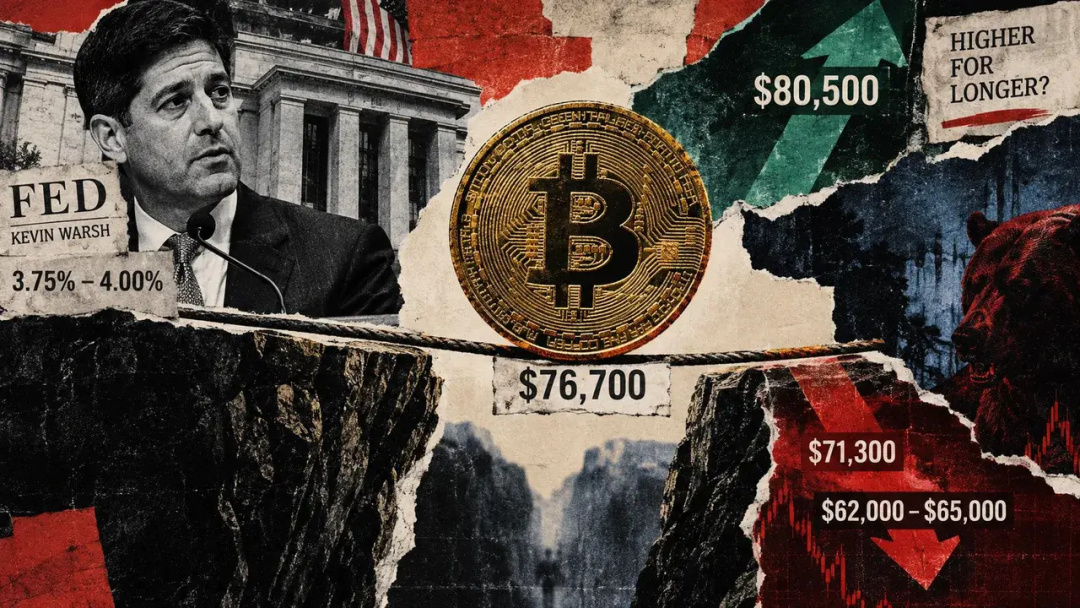
Bitcoin fell to an intraday low of $75,064.82 on September 16, but managed to recover and reclaim the $76,000 zone after Federal Reserve Chair Kevin Warsh's press conference concluded. During this period, the S&P 500 declined approximately 0.7%, while the Dow dropped by 1.2%. The 2-year Treasury yield also increased to 4.734%. The Federal Reserve raised its target range by 25 basis points to 3.75% to 4.00% in a unanimous vote, with fixed-income derivatives having already priced in a high probability of this move before the meeting. Warsh stated that he would be "hard pressed" to label broad financial conditions as restrictive. A dot plot released alongside the decision indicated that 16 out of 18 policymakers expect at least one more rate hike this year. This situation raises concerns for liquidity-sensitive assets, as the impact of a single quarter-point move may not be sufficient to stabilize the market. Markus Levin, co-founder of XYO, emphasized that the hike itself was not the primary concern. He noted that rates are likely to remain restrictive for longer than investors anticipated. Levin is closely monitoring Treasury yields and liquidity conditions rather than focusing solely on the Fed's headline decision, suggesting that Bitcoin has already absorbed much of the higher-rate expectations leading up to this meeting. If Treasury yields stabilize, Bitcoin could continue to trade based on institutional demand and improving liquidity. However, a series of additional priced-in hikes could negatively affect risk assets overall. Glassnode's latest on-chain report indicates that Bitcoin is trading just below its $76,700 True Market Mean, which is the average price paid by active investors. The report also highlights a simultaneous weakening across all major demand channels. Realized Cap recorded its first negative daily reading, breaking a 27-day growth streak. Additionally, US spot Bitcoin ETFs saw net outflows of $450.4 million on September 15, with significant withdrawals from FBTC and IBIT. The stablecoin supply remains near $301 billion, flat for the week and approximately 4% below its April peak. Corporate treasury purchases have slowed significantly, with only 5,900 BTC acquired over the past three months, a stark contrast to the 89,000 BTC purchased in July 2025 alone. This slowdown leaves the buyers' average cost basis of $80,500 as a resistance level. Fabian Dori, chief investment officer at Sygnum Bank, characterized this slowdown as a structural liquidity issue that extends beyond any single Federal Reserve meeting. He pointed out that treasury cash balances, private credit creation, and stablecoin supply influence market conditions over a longer timeframe than any individual meeting. Glassnode's criteria require daily closes to assess the situation, extending beyond any single intraday price point. A second daily close below $76,700 would confirm a genuine range break, potentially leading to a decline toward the $71,300 short-term holder cost basis and the $62,000 to $65,000 zone where deeper accumulation occurred earlier this year. Conversely, two daily closes above $76,700, along with renewed Realized Cap growth, could restore the previous range and bring the $80,500 corporate cost basis back into play as the next target. Martin Lee, market insights lead at DWF Labs, identified immediate risks just below the current price, warning that vulnerable long positions exist between $75,000 and $76,000. He cautioned that a sustained hawkish stance from the Fed could force risk-on assets to adjust to a higher-for-longer reality, extending beyond the implications of a single rate hike. Lewis Huang, an analyst at Bitget, noted that Bitcoin has historically reacted to major rate-driven days by absorbing approximately four times the S&P 500's movement. Core annual inflation recently hit a five-year low, primarily driven by rising gasoline prices. Huang warned that these pressures could reverse more quickly than underlying inflation, raising the risk that the Fed continues tightening beyond the point where the energy shock justifying it has faded. The bullish scenario for Bitcoin involves closing above $76,700 on consecutive days, with Realized Cap growth resuming and ETF inflows returning now that the Fed's decision is behind the market. Matt Mena, senior crypto research strategist at 21Shares, set a year-end target of $100,000 based on this scenario, citing over $3 billion in Bitcoin ETF inflows in the past two months and Bitcoin's historical tendency to find a floor near current levels before reaching new highs. The bearish scenario involves a second daily close below $76,700, coupled with ongoing ETF redemptions and stagnant stablecoin supply. Under this scenario, Bitcoin's recent stability could be interpreted as quiet distribution rather than genuine strength. A break below the $71,300 short-term holder floor would expose diminishing order-book liquidity, which Glassnode indicates is largely evaporating below $68,000, leaving the deeper $62,000 to $65,000 accumulation zone as the next significant test. Bitcoin successfully passed its first test by not declining alongside other assets this week. However, whether this is a sign of strength will depend on future capital inflows or continued absence from the market.
For Your Trading Desk
Sponsor Spike Success.