NVIDIA Unveils Powerful Rubin GPU Architecture
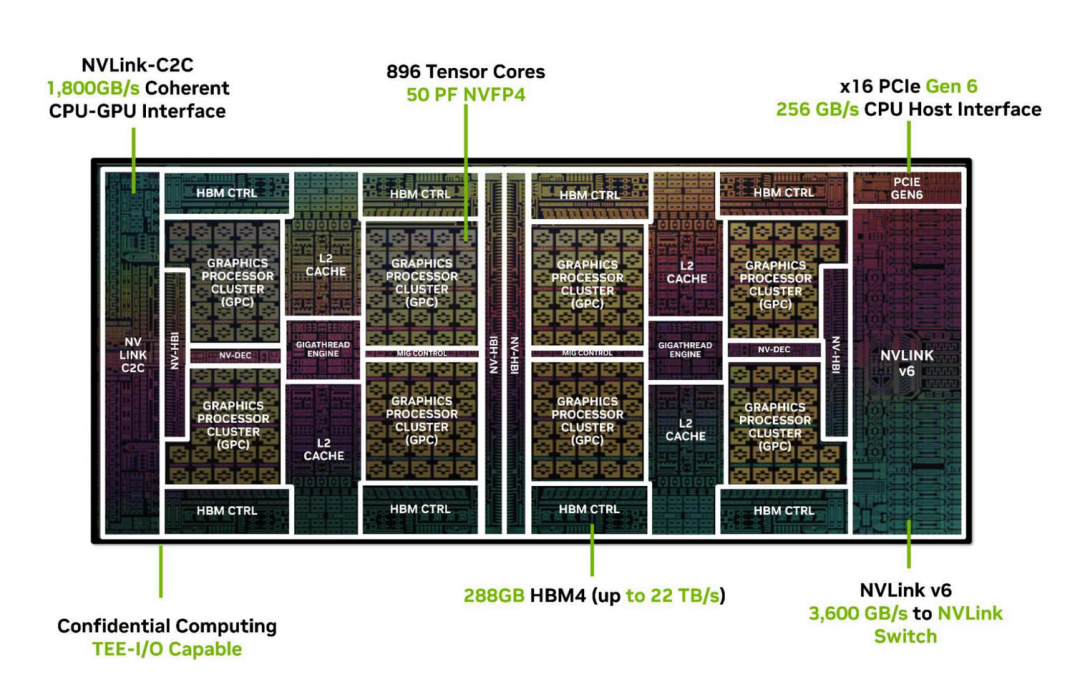
NVIDIA has unveiled its latest GPU architecture, known as Rubin, marking a significant advancement in the company's efforts to scale computing across multiple racks and data centers. The Rubin GPU is capable of delivering an impressive 50 PetaFLOPS of compute power, particularly excelling in sparse NVFP4 operations. In its full configuration, the architecture includes up to 224 streaming multiprocessors (SMs) and 288 GB of HBM4 memory, supported by a staggering 336 billion transistors. This setup integrates 896 Tensor Cores along with a third-generation Transformer Engine, enhancing its computational capabilities.
To maximize raw compute power, NVIDIA organizes its GPU resources into Graphics Processor Clusters (GPCs), which feature a centralized L2 cache. The GigaThread Engine plays a crucial role in coordinating workflows and optimizing resource utilization across the GPU. Additionally, the architecture incorporates MIG Control partitions, allowing the GPU to be segmented into multiple virtual GPUs, akin to how modern CPUs manage virtual cores.
For Your Trading Desk
Sponsor Spike Success.
On the memory front, NVIDIA has partnered with memory manufacturers to provide 288 GB of HBM4 memory through 12-high modules. This setup includes dedicated HBM controllers and physical layers, achieving a peak memory bandwidth of up to 22 TB/s, positioning it competitively within the industry. The Tensor Memory Accelerator has also been updated to improve data movement efficiency, while NVLink 6 manages communication across the GPU, offering 3,600 GB/s of fabric bandwidth for all-to-all GPU communications and 1,800 GB/s for CPU-GPU interactions.
One of the standout features of the Rubin architecture is its scale-up communication capability, which allows for effective GPU communication within rack-scale systems. Traditionally, GPU-to-GPU communication can introduce latency due to the need for coordination and synchronization. However, Rubin addresses this by implementing device-initiated communication, enabling each GPU to independently manage data transfers, thus reducing latency and enhancing overall performance.
Power consumption is a critical consideration for systems utilizing multiple GPUs. The NVL72 rack, which houses 72 GPUs, has seen significant advancements with the introduction of Intelligent Power Smoothing. This technology integrates all system components into a single fixed power envelope, allowing for more efficient power management during fluctuating workloads. For example, during AI tasks, power demand can rapidly shift from idle states to full utilization. With Intelligent Power Smoothing, the Vera Rubin NVL72 systems achieve an average power consumption reduction of approximately 10% compared to the previous Grace Blackwell NVL72, while also decreasing peak power demands by about 20% over 50 ms. Additionally, power budget optimization is further enhanced through NVIDIA's DSX MaxLPS, ensuring that the systems operate efficiently under varying loads.