Understanding Market Timing: The Impact of Missing Key Days
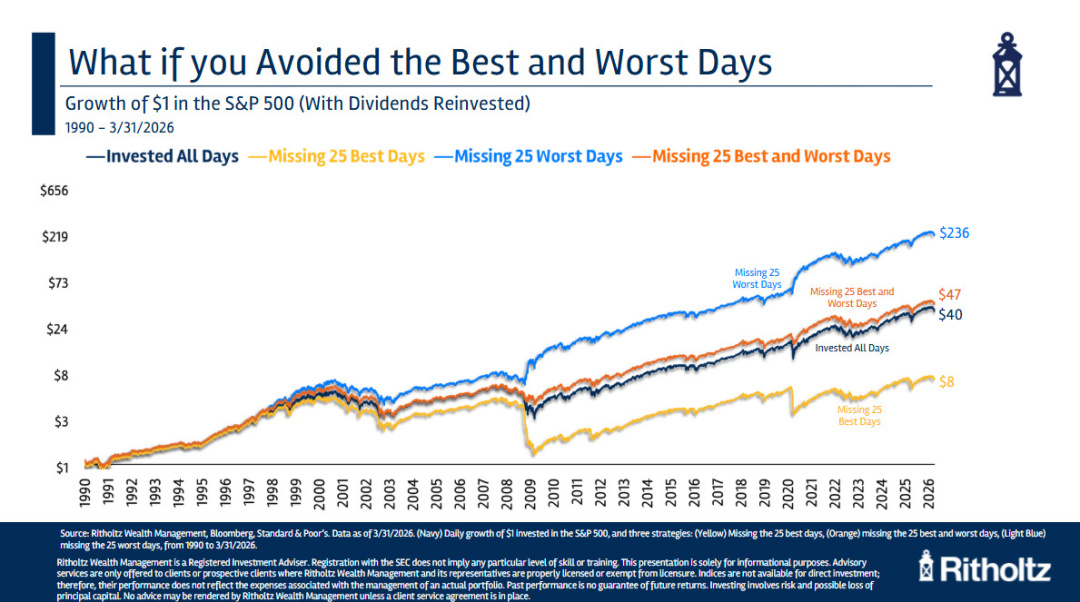
The dynamics of market timing often evoke two well-known parables in investing. One story features Bob, dubbed the world's worst market timer, who exemplifies the power of compounding and the necessity of remaining invested, regardless of poor entry points. Conversely, a statistic frequently cited by market analysts, including Tom Lee, asserts that missing just the ten best days in the market over a decade can severely impact overall returns, potentially rendering them negative. This raises the question of how these two concepts intersect and whether Bob's success hinges on inadvertently capturing those best days by never selling, even during downturns.
Data from JP Morgan illustrates the consequences of missing key market days. For instance, missing the ten best days can reduce annual returns by 40%. If an investor missed the 25 best days since 1990, a dollar would have grown to only eight dollars, compared to forty dollars for those who remained fully invested. In contrast, avoiding the 25 worst days would have resulted in a dollar growing to nearly 240 dollars. However, if one could avoid both the best and worst days, the growth would align more closely with the long-term buy-and-hold strategy.
For Your Trading Desk
Sponsor Spike Success.
The clustering of best and worst days is a significant factor in this discussion. Historical data shows that these extreme days often occur during turbulent market conditions, such as the dot-com bust, the 2008 financial crisis, the Covid crash, and the 2022 inflation bear market. This clustering can be attributed to heightened volatility, where investor emotions fluctuate dramatically, leading to panic selling and buying. The psychological phenomenon of herding, as described by French psychologist Gustave Le Bon, suggests that individuals in a crowd often act collectively, which can exacerbate market movements during periods of uncertainty.
Bob's experience as a market timer illustrates the importance of a long investment horizon. Despite his poor timing, he was still subject to the market's best and worst days, which typically follow market peaks. This reality underscores the difficulty of timing the market, particularly in declining markets where emotional responses can lead to erratic trading behavior. Ultimately, Bob's long-term approach may have shielded him from the worst outcomes, but it also highlights the inherent challenges investors face in navigating market volatility.