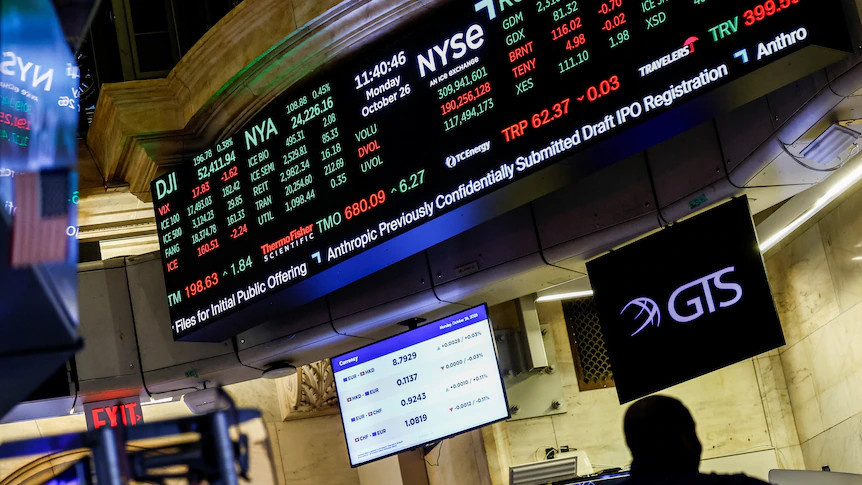
Anthropic's Nasdaq Debut Highlights Market Concerns Amid Tech Sell-Off

US artificial intelligence developer Anthropic made its Nasdaq debut on November 19, with shares finishing 17% above their offering price despite sharp declines in Japanese and American technology stocks. This situation highlights growing concerns that the substantial investments fueling the AI boom may be outpacing the industry's ability to generate sustainable profits.
Anthropic, known for its Claude generative AI platform, attracted significant investor interest, marking one of the year's most closely watched stock market listings. Shares opened at $111.50, approximately 34% above the offering price of $83, before closing at $97.17, reflecting a gain of about 17%. The company briefly reached a fully diluted valuation of around $2 trillion, placing it among the most valuable companies to enter public markets.
For Your Trading Desk
Sponsor Spike Success.
However, the successful listing did not reverse a broader downturn in technology shares. Semiconductor manufacturers and AI-related companies faced heavy selling in both Japan and the United States, while the S&P 500 fell roughly 2% as investors reassessed expectations for continued growth in artificial intelligence. Market sentiment had already deteriorated over the preceding month, reflecting uncertainty over whether the unprecedented expansion in AI infrastructure spending could continue.
Some investors had hoped that Anthropic's listing would revive enthusiasm for the sector, but the market's response suggested that financial performance was becoming more critical than expectations of technological breakthroughs. Analysts noted that this trading could signify a turning point, where the AI investment boom, which accelerated following the introduction of ChatGPT in late 2022, is increasingly judged against measurable business results rather than mere predictions about AI's transformative potential.
Despite the broader market weakness, Anthropic's reception was considered relatively strong. The company's financial disclosures indicated rapidly expanding revenue and improving operating efficiency, which helped sustain demand for its shares even as technology stocks elsewhere declined. In its most recent quarter, Anthropic's revenue was approximately 12 times higher than the level recorded a year earlier, and its adjusted operating performance had moved into positive territory after excluding certain one-time factors. These improvements suggested that Anthropic was beginning to demonstrate the commercial viability of developing and selling advanced AI models.
Founded in 2021, Anthropic reached a valuation approaching $2 trillion in just five years, showcasing the extraordinary speed at which companies can grow in the American technology industry. Its listing also marked a significant development for financial markets, as investors could directly assess a company focused on developing artificial intelligence rather than manufacturing semiconductors or operating cloud computing services.
Until now, much of the AI investment boom has been reflected in the share prices of semiconductor manufacturers like Nvidia and major technology companies such as Microsoft, Amazon, and Google. These businesses provide the chips, data centers, and computing infrastructure necessary for developing and operating AI systems. Anthropic's emergence as a publicly traded company introduces another way of measuring the industry's health, with its revenue growth, profitability, and computing expenses potentially becoming leading indicators of demand throughout the AI supply chain.
The company's commercial strategy has attracted attention due to its emphasis on enterprise customers rather than the broader consumer market. Anthropic was established by Dario Amodei and other former OpenAI employees who prioritized AI safety and responsible development. While both companies share a technological approach built around improving AI performance through larger datasets and greater computing power, their commercial priorities have diverged.
Anthropic has focused on providing advanced AI systems to businesses, including tools that can connect with corporate data and support professional workflows. Its Claude platform has gained traction in sectors such as financial services, document preparation, analysis, and software development. One of its most successful products, Claude Code, an AI-powered programming assistant introduced in 2025, has become a significant revenue source by enabling developers to automate increasingly complex software engineering tasks.
Industry analysts view Claude Code as a major commercial breakthrough, as professional users are willing to pay for tools that deliver measurable improvements in productivity. This service also generates substantial demand for computing resources, creating both revenue opportunities and operational challenges. Anthropic's ability to develop products specifically for enterprise customers has helped differentiate its business from rivals offering more general-purpose AI services.
Some corporate users have adopted Claude as their primary AI system for document creation and other professional activities while retaining ChatGPT and Google's Gemini as alternatives depending on the task, subscription costs, and computing requirements. Claude's growing reputation has also strengthened Anthropic's position in the competitive market for advanced AI models. The development of its powerful Mythos model and the attention surrounding restrictions on its release have contributed to perceptions that Anthropic is challenging OpenAI's technological leadership.
The company's progress has increased scrutiny of OpenAI, which is considering a stock market listing from 2027 onward after postponing earlier plans. OpenAI faces pressure in two major markets: in enterprise services, where Anthropic has established a strong position, and in consumer AI applications, where Google's Gemini has intensified competition through aggressive pricing and integration into existing services.
Concerns Over AI Operating Costs and Revenue Growth
Analysts have questioned whether OpenAI can establish a sufficiently distinctive commercial strategy to support a future listing, particularly if Anthropic continues expanding its enterprise business. For Anthropic, however, rapid revenue growth has not eliminated concerns about the enormous cost of operating advanced AI systems. The company's revenue reached approximately $17 billion for the measure presented for July 2026, representing an increase of roughly 43 times over the preceding 18 months. Its financial performance also indicated that revenue had overtaken the direct costs of operating and maintaining its AI services, suggesting improving efficiency.
The relationship between revenue and computing expenses is becoming one of the most closely watched measures of profitability in the industry. AI developers must pay substantial amounts to operate data centers equipped with specialized processors. The cost of providing a service depends not only on the number of users but also on the complexity of their requests and the computing power required to generate responses. More sophisticated tasks can consume considerably more processing capacity than simple questions, while newer, more powerful chips often carry higher operating costs.
This creates particular difficulties for subscription services, where customers may pay a fixed monthly fee but use widely varying amounts of computing resources. Heavy usage can reduce profitability, forcing providers to manage processing costs carefully. Although Anthropic has steadily improved its operating efficiency, analysts have observed that computing costs have recently increased again, putting some pressure on margins.
Whether the company can maintain revenue growth while controlling these expenses will be central to determining whether its business model can support continued expansion. The scale of its future financial commitments presents an even greater challenge. Anthropic's IPO prospectus devoted over 90 pages to risks, including financial obligations associated with securing computing infrastructure. The company has committed to approximately $900 billion in infrastructure-related payments through 2045 under agreements with major technology providers including Amazon, Google, and Microsoft.
These commitments grant Anthropic access to the enormous computing capacity required to develop increasingly advanced AI systems, but they also expose the company to considerable financial risk if demand fails to grow as expected. Much of the spending is contractually committed, meaning weaker-than-anticipated revenue could rapidly undermine profitability. The danger is compounded by intense competition, as rival AI developers may introduce superior models, lower their prices, or attract customers away from Anthropic, reducing revenue while leaving substantial infrastructure obligations unchanged.
Another challenge is the short commercial lifespan of advanced AI models. According to the company's disclosures discussed by analysts, approximately 80% of its recent revenue came from models developed within the preceding six months. This figure illustrates how quickly technology can become outdated. Models requiring enormous development expenditure can lose their competitive advantage within months as rival companies release more capable systems. Anthropic must therefore continue investing heavily in research and computing infrastructure simply to maintain its position.
Customer loyalty also presents a potential weakness. Unlike social media platforms, where users may be reluctant to leave due to their contacts and accumulated content, AI applications can often be replaced relatively easily. Businesses using AI models through application programming interfaces may switch providers by modifying small amounts of software code, reducing the barriers preventing customers from moving between competing services and making technological leadership particularly difficult to sustain.
Although Claude currently enjoys strong support among developers and enterprise customers, analysts warn that a leading AI system today could quickly be overtaken by a competitor. Anthropic also remains dependent on the companies supplying its computing infrastructure. While Nvidia has dominated the broader market for AI processors, Anthropic has increasingly relied on specialized tensor processing units developed in cooperation with Google, creating important relationships with Google and semiconductor supplier Broadcom.
Disruptions involving these partners, as well as critical manufacturers such as Taiwan Semiconductor Manufacturing Co., could significantly impact the company's ability to expand its services. The close connections between AI developers, semiconductor manufacturers, and cloud computing providers mean that financial or operational difficulties affecting one part of the industry could quickly spread throughout the supply chain.
Navigating Challenges in AI Commercialization and Investor Sentiment
Despite these risks, Anthropic's success with Claude Code has demonstrated that carefully targeted AI applications can become substantial businesses. Its decision to concentrate on software development and enterprise productivity has helped the company establish a commercially valuable position in an increasingly crowded market. Competition is intensifying as other technology companies develop AI agents for specialized tasks. For investors, Anthropic's IPO represents both a milestone in the commercialization of artificial intelligence and a test of whether the sector's enormous valuations can be supported by long-term earnings.
The company's rapid expansion has shown that demand for advanced AI services can generate substantial revenue, but its dependence on costly infrastructure, constant technological improvements, and customers able to change providers presents significant challenges. The contrasting performance of Anthropic's shares and the broader Japanese and American stock markets suggests that investors are becoming more selective about AI-related investments, with increasing attention focused on profitability, competitive advantages, and the ability to recover the enormous sums being committed to the technology. Rather than signaling the end of the AI boom, Anthropic's listing may mark the beginning of a more demanding phase in which companies must demonstrate that their technological achievements can translate into sustainable financial returns.